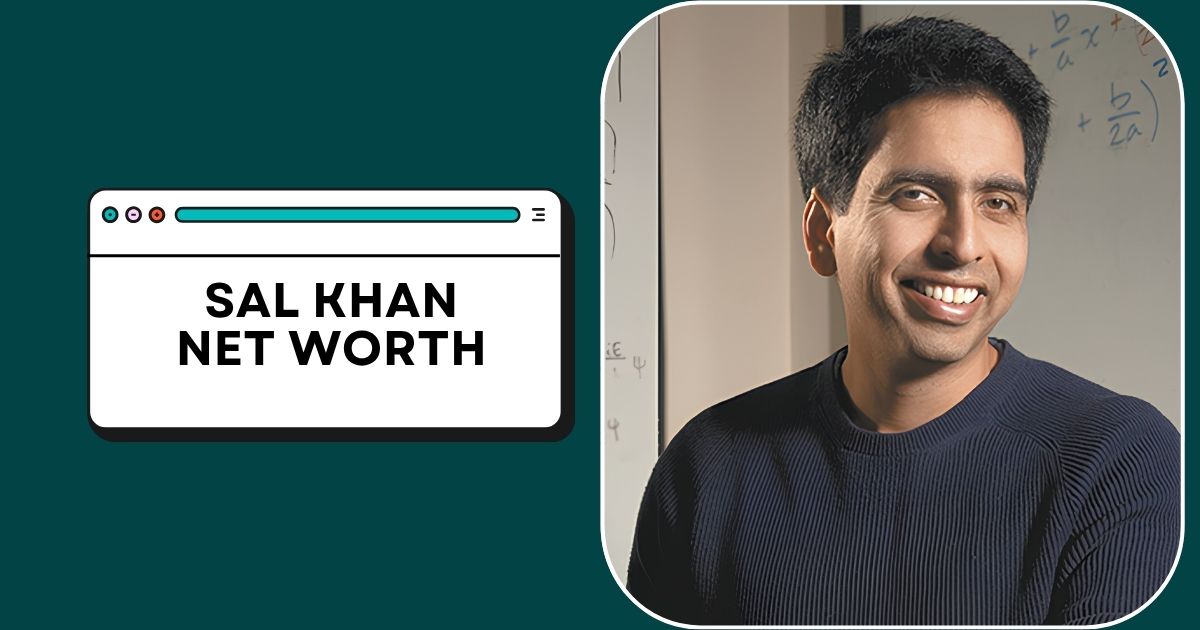

Type “Sal Khan net worth” into Google and you’ll get answers ranging from $1.5 million to $1.5 billion. Both can’t be right, and neither is officially confirmed, because Sal Khan built something almost no other tech founder builds: a global platform with zero personal equity attached to it.
Khan Academy serves more than 180 million registered users across 190 countries. Sal Khan doesn’t own a single share of it. He can’t sell it, take it public, or cash out. What he does have is a documented CEO salary, filed with the IRS every year, that tells a far more grounded story than the wild numbers floating around the internet.
This article walks through what’s actually verified, what’s guesswork, and why so many “net worth” pages about him contradict each other.
Sal Khan’s Early Life
Salman Amin Khan was born on October 11, 1976, in Metairie, Louisiana, to immigrant parents: his father, a pediatrician from Bangladesh, and his mother, from India. He grew up in New Orleans, raised primarily by his mother.
Academically, Khan was the kind of student most parents dream about. He earned three separate degrees from MIT:
- A Bachelor of Science in mathematics
- A Bachelor of Science in electrical engineering and computer science
- A Master of Engineering in electrical engineering and computer science
He graduated in 1998 and later added an MBA from Harvard Business School, reconnecting there with a woman he’d known at MIT, Umaima Marvi, who was finishing her medical training.
The origin story that actually built Khan Academy has nothing to do with any of those degrees. In 2004, while working in finance, Khan started tutoring his young cousin Nadia over the phone, using an early interactive notepad to walk her through math problems she was struggling with, particularly unit conversion. Word spread through the family, and soon he was informally tutoring more than a dozen cousins and friends. Scheduling became impossible, so in 2006 he began recording short lessons and posting them to YouTube instead. The channel grew almost entirely through word of mouth, with no marketing budget and no ad spend.
Read More: Dallas Yocum Bio: Mike Lindell’s Ex-Wife, Career & Divorce
Sal Khan Career
Before any of this, Khan had a conventional, high-earning trajectory. After MIT, he spent a year at Oracle, then joined a venture capital startup during the dot-com crash. After Harvard Business School, he became a hedge fund analyst at Connective Capital Management, first in Boston and later in Palo Alto, a stable, well-compensated job that most people wouldn’t walk away from casually.
That’s exactly what makes 2009 the turning point. As his YouTube tutoring videos kept growing in popularity, Khan made the decision to leave finance entirely and build his side project into a full-time nonprofit. Early support came from people who recognized the platform’s potential before most of the education industry did:
- Ann Doerr, an early individual backer and later board chair, provided crucial early funding
- Google contributed $2 million in 2010 to help translate lessons into major world languages
- The Bill and Melinda Gates Foundation provided early growth funding, helping Khan Academy scale from a one-person operation into a real organization
By 2012, the impact was impossible to ignore. Khan was named to TIME’s 100 Most Influential People list and landed on the cover of Forbes with the headline “The $1 Trillion Opportunity.” He published his first book, The One World Schoolhouse: Education Reimagined, the same year. In 2014, he founded Khan Lab School, a physical campus in Mountain View, California, designed to test mastery-based learning in a real classroom setting. India awarded him the Padma Shri, one of its highest civilian honors, in 2016.
Sal Khan Net Worth
Here’s the direct answer: there is no verified, official figure for Sal Khan’s personal net worth. What exists instead is public salary data, because Khan Academy is a registered 501(c)(3) nonprofit and files an IRS Form 990 every year, a document that legally requires disclosure of top executive compensation.
According to those filings, tracked and analyzed through outlets like ProPublica’s Nonprofit Explorer and independent tax-return reviews of Khan Academy’s public records, Khan’s disclosed compensation has climbed steadily:
- Around $348,000 in 2013
- Roughly $824,000 to $839,000 in 2018 and 2019
- About $856,000 in 2021
- Approximately $871,000 in the most recent filing year available (2025)
He has consistently been Khan Academy’s highest-paid employee, but his compensation is set by an independent board committee, not chosen unilaterally by Khan himself, a standard nonprofit governance safeguard against self-dealing.
How the Money Actually Works
To understand why Sal Khan isn’t a billionaire despite running one of the most-used education platforms on earth, it helps to break down exactly where his income comes from and where it doesn’t.
His documented income sources include:
- CEO salary from Khan Academy, publicly disclosed through Form 990 filings
- Book royalties, from The One World Schoolhouse (2012) and Brave New Words (2024)
- Speaking fees, typical for someone with his public profile, though exact figures aren’t disclosed
What’s explicitly excluded from any legitimate net worth estimate:
- Khan Academy’s organizational revenue, assets, and donor funds, which belong to the nonprofit, not to Khan personally
- Any theoretical “equity value” of Khan Academy, since nonprofits don’t issue shares and can’t be sold
- Unconfirmed personal investments, which aren’t part of any public record
Given roughly two decades of salary in the $350,000 to $870,000 range, plus modest royalty and speaking income, a reasonable evidence-based estimate would place Khan’s personal net worth in the low-to-mid single-digit millions, with real uncertainty on the upside depending on personal investments nobody has confirmed. That’s a world away from the $200 million to $1.5 billion figures that circulate on some aggregator sites.
Read More: Who Is Gianluca Cugnetto? Age, Net Worth, and Career
The Peer Comparison Table
Comparing Khan to other well-known founders helps explain why the nonprofit structure matters so much for wealth calculations.
| Founder | Organization | Business Structure | Personal Equity | Compensation Model |
| Sal Khan | Khan Academy | Nonprofit (501c3) | None | Board-set salary, disclosed via Form 990 |
| Jimmy Wales | Wikipedia / Wikimedia Foundation | Nonprofit | None | Took $0 salary from the foundation for years; commonly cited net worth around $1 to $1.5 million |
| Daphne Koller | Coursera | For-profit, publicly traded (NYSE: COUR) | Founder equity and stock | Standard public-company pay plus equity that rises and falls with share price |
The pattern holds across the nonprofit world. Founders who build charitable organizations, whether it’s Khan Academy or Wikipedia, cap their personal financial upside by design. Founders who keep equity in a for-profit structure, like Coursera’s Daphne Koller, build wealth the traditional startup way, tied directly to company performance and market value.
Uncomfortable Truth
Most “Sal Khan net worth” articles online are recycled guesses that never touch a primary source. Many read like content churned out without checking IRS filings or Khan Academy’s own financial disclosures. A significant chunk of the inflated numbers also come from a simple mix-up: confusing Sal Khan, the American nonprofit educator, with Salman Khan, the unrelated Bollywood film star worth hundreds of millions of dollars. Once that confusion enters an aggregator’s database, it gets copied across dozens of low-effort sites.
Unanswered Question
What is Khan’s actual personal net worth, separate from Khan Academy’s brand value, donor assets, or future ventures like the Khan TED Institute? No public filing answers that directly, because nonprofit founders almost never publish a personal balance sheet. Until Khan chooses to disclose one, this remains a genuinely open question rather than a hidden number waiting to be uncovered.
Methodology Transparency
The estimate in this article combines Khan’s disclosed nonprofit salary from Form 990 filings spanning more than a decade, publicly known book deal patterns for nonfiction authors with his profile, and typical speaker fees for someone at his level of visibility. It deliberately excludes Khan Academy’s organizational revenue, donor contributions, and total assets, since those legally belong to the nonprofit and never pass through to Khan personally. That distinction is exactly where most inflated net worth estimates go wrong.
Personal Life
Khan married Umaima Marvi, a physician, in 2004, the same year he began tutoring Nadia. The couple has raised their children, reported as three in more recent biographical records, in Mountain View, California, near Khan Academy’s headquarters. Their oldest child dealt with childhood epilepsy, which he later outgrew, an experience Khan has said reshaped the family’s priorities.
Khan has kept his family life notably private for someone with his public profile. He’s not associated with luxury spending, high-visibility philanthropy galas, or the lifestyle signals that typically follow founders of platforms this large. He serves as a board member of the Aspen Institute, and in October 2025, TED named him its new Vision Steward, succeeding longtime TED curator Chris Anderson.
Philanthropy: Khan Academy Is the Philanthropy
For most wealthy individuals, philanthropy is something separate from their main career, a foundation set up after the fortune is made. For Khan, the giving and the working are the same act. Every dollar Khan Academy raises from donors like the Gates Foundation, Google, and other major backers goes directly into free educational content rather than into his personal accounts.
Beyond Khan Academy itself, he has extended that same free-access model to other projects:
- Khan Lab School, founded in 2014, testing mastery-based, in-person learning
- Schoolhouse.world, launched in 2020 during the pandemic, connecting students worldwide with volunteer tutors through live video sessions, with certifications recognized by institutions including the University of Chicago, MIT, and Caltech
- Khan Academy Kids, a free early-learning app he developed with his wife
None of these generate personal income for Khan. They function as an extension of the same mission, which is precisely why untangling “Sal Khan the person’s” finances from “Khan Academy the organization’s” finances is so difficult, and why so many online estimates get it wrong.
Controversies: The Khanmigo Reality Check
Khanmigo, Khan Academy’s GPT-4-powered AI tutor, launched in March 2023 with enormous ambition. Khan predicted publicly that AI tools like it would eliminate 90% of teachers’ administrative workload by the end of 2024. That prediction didn’t hold up, and Khan later pushed the same forecast out to 2034 instead.
The reality on the ground has been more complicated than the early hype suggested:
- Industry reporting has put regular classroom engagement with Khanmigo at around 15% of students in enabled classrooms, a figure Khan has publicly acknowledged
- Khan Academy ran a six-month internal review, from October 2025 through April 2026, specifically to understand why engagement fell short of expectations
- A major product redesign, aimed at closing that gap, began rolling out to district partners in summer 2026
- A randomized controlled trial testing whether Khanmigo measurably improves learning outcomes is expected to report results by mid-2026
To Khan Academy’s credit, it published its own findings and shortfalls rather than burying them, an unusually candid move for an edtech product facing adoption problems. A partnership with Microsoft, announced in 2024, donated Azure AI infrastructure that let Khan Academy make Khanmigo for Teachers free across the U.S., removing what had been a $4-per-month cost barrier. In January 2026, Khan Academy also began working with Google to power its Writing Coach feature using Gemini’s LearnLM, an interesting dynamic given that Google’s own AI tools compete directly with Khan Academy for classroom attention.
Legacy: What It Costs to Give Something Away
Every year Khan stays at Khan Academy is another year he doesn’t build personal equity in the thing he created. That’s not an accident or an oversight; it’s the entire premise of the organization. He had the credentials, the finance background, and the timing to build a for-profit edtech company instead, the same wave that helped launch Coursera, edX, and Udacity, all of whose founders have credited Khan Academy as direct inspiration.
He chose the nonprofit path anyway, and stuck with it through nearly two decades of scale that would have made a for-profit founder extraordinarily wealthy. That tradeoff, choosing global reach and free access over personal fortune, is the actual story behind “Sal Khan net worth,” far more than any single dollar figure could capture.
Sal Khan’s Current Activities (as of 2026)
Khan’s newest and most ambitious project is the Khan TED Institute, announced in April 2026 at the TED2026 conference in Vancouver. It’s a joint venture between Khan Academy, TED, and ETS (the nonprofit behind the GRE and TOEFL), aiming to offer a Bachelor’s degree in Applied AI for under $10,000 total, positioned as a direct, low-cost alternative to elite university tuition that now tops $65,000 to $68,000 a year at schools like Harvard and Stanford. Corporate partners reportedly involved in shaping the curriculum include Google, Microsoft, McKinsey, Bain, and Accenture. The institute isn’t accredited yet and isn’t expected to open applications until roughly 2027, and some higher-education observers remain skeptical about whether an unaccredited, AI-centric curriculum can prove its value to employers and traditional accreditors.
Alongside that launch, Khan Academy continues:
- Refining Khanmigo based on its 2025-2026 internal research findings
- Expanding Schoolhouse.world’s peer-tutoring network globally
- Deepening its Microsoft partnership around Azure OpenAI infrastructure
- Serving as TED’s Vision Steward, shaping the organization’s future direction
Conclusion
Sal Khan’s net worth isn’t a mystery because it’s hidden. It’s uncertain because it’s genuinely small compared to the size of what he built, and because he structured Khan Academy so that its growth could never convert into his personal fortune. The verified numbers, a rising but modest nonprofit salary, book royalties, and standard speaking fees, tell a far more interesting story than any inflated billion-dollar guess ever could. In an industry full of founders who cashed out, Sal Khan is the rare one who deliberately didn’t, and 180 million learners have been the direct beneficiaries of that choice.
FAQs
Is Sal Khan a billionaire?
No. There is no verified evidence supporting billionaire-level wealth. His only publicly confirmed income is a nonprofit CEO salary in the high six figures.
Why do net worth websites report such different numbers for Sal Khan?
Most figures are unverified estimates copied between aggregator sites, and many results also mistakenly mix in data belonging to Bollywood actor Salman Khan.
Does Sal Khan own any part of Khan Academy?
No. Khan Academy is a 501(c)(3) nonprofit with no shares or equity, so Khan cannot personally profit from its growth or valuation.
How much does Sal Khan earn as Khan Academy’s CEO?
Public Form 990 filings show his compensation has risen from around $348,000 in 2013 to roughly $871,000 in the most recent available filing.
Does Sal Khan make money from Khanmigo?
No. Khanmigo is a Khan Academy product, and any revenue it generates supports the nonprofit’s operations rather than Khan’s personal income.

Morgan White, the voice behind Blessing Hubz, delivers heartfelt reflections and meaningful blessings designed to encourage hope, uplift the soul, and bring warmth and positivity to everyday life.